
How to Stop Your Dog from Pulling on the Leash
If you've ever come home from a walk feeling like you ran a half marathon while your dog did all the driving, you're not alone. Leash pulling is probably the number one complaint I hear from dog owners. And the good news is it's completely fixable — but it requires a little patience and a shift in how you think about walks.
Let me explain what's actually happening, and then we'll talk about what to do about it.
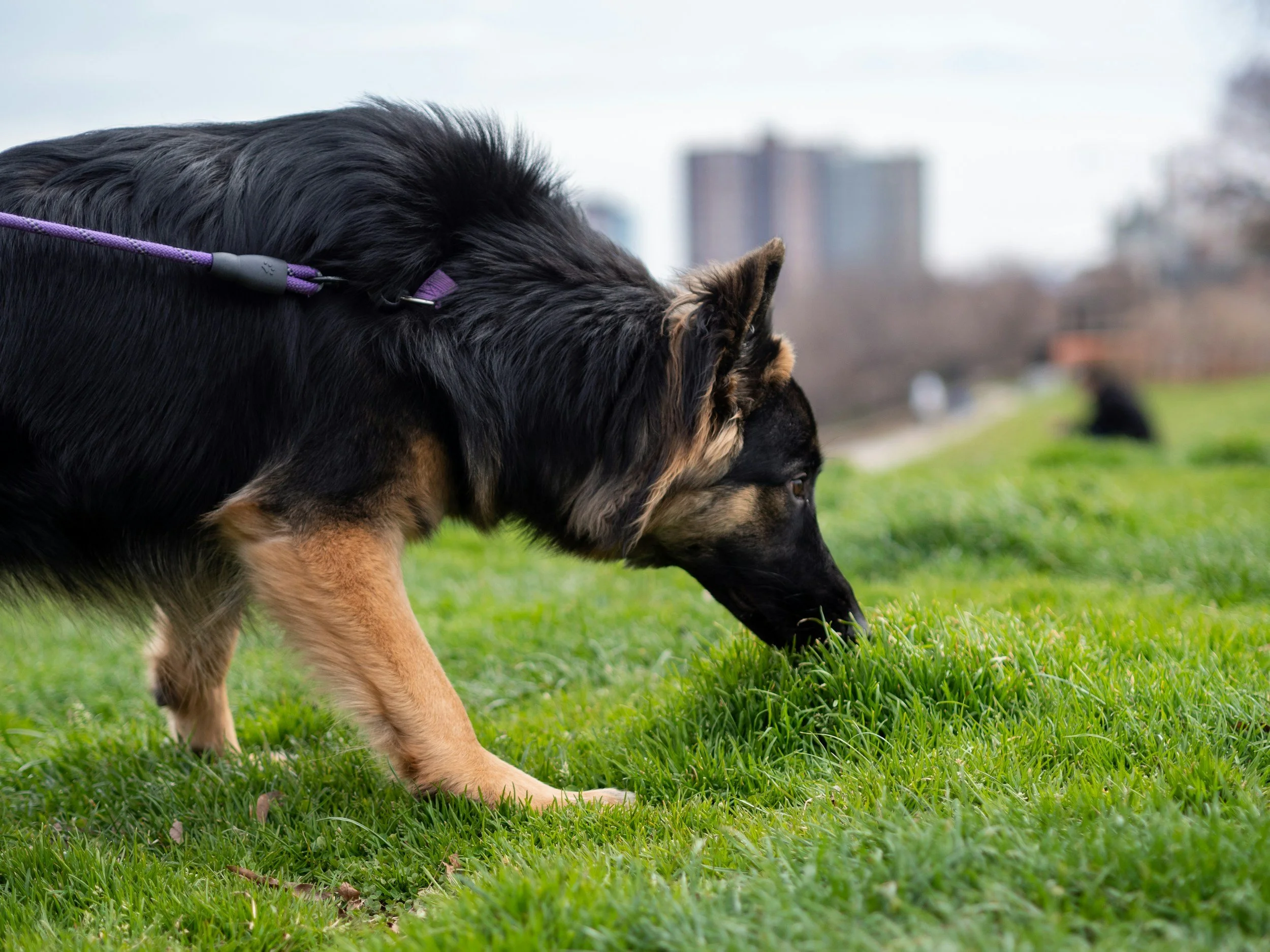
Why dogs pull
Dogs pull on the leash because it works. That's really it. Your dog wants to get to the fire hydrant, the other dog, the interesting smell on the corner — and every time they pull forward and you follow, they learn that pulling is the way to get where they want to go.
There's no dominance happening, no power struggle, no disrespect. Your dog is just doing what has always worked. Our job is to change that equation.
What doesn't work
Before we get into what to do, let me save you some time on what to skip.
Jerking the leash, prong collars, and choke chains and electronic collars can suppress pulling temporarily, but these are all punishment based, which means you are actively hurting your dog or at the very least adding discomfort. The dog stops pulling, not because they've learned anything about walking nicely, but because they are uncomfortable. The moment the discomfort is gone, the pulling usually comes back. And in the meantime, you've introduced a lot of stress into something that should be enjoyable for both of you.
The other thing that doesn't work is just repeating "heel" or "easy" over and over without having actually taught those words. Like I talk about in the barking post — if you haven't taught a cue, your dog genuinely doesn't know what it means. Oh, and saying it louder, doesn't help!
The core principle: a tight leash never gets you anywhere
This is the concept that underpins everything we're going to do. Your dog needs to learn that a loose leash moves the walk forward, and a tight leash stops it completely.
You're going to need to be consistent about this, especially at the beginning. Every single time the leash goes tight, the walk stops. Every single time your dog comes back to you and the leash goes slack, the walk continues. You're teaching them a very clear rule.
How to start — the basics
Before you head out for a full walk, you’ll need to practice in a low-distraction environment. Somewhere quiet, where you are the most interesting thing around. We want your dog to succeed right away, and the street with squirrels and other dogs and bicycle bells is not the place to start.
Step 1: Load up on treats. Get a variety of low and high value treats. Think kibble and also cheese and hot dogs. Put your dog in a regular snap or buckle collar with a six-foot, flat leash. Absolutely no expandable leashes.
Step 2: Start walking. The moment the leash goes tight, stop completely. Don't say anything, don't pull back, just stop. Plant your feet.
Step 3: Wait. Your dog will eventually turn around to figure out why you've stopped. The moment they do — the moment there's any slack in the leash — mark it with a cheerful "yes!" and give them a treat. This places them by your side again, feed on the same side every time so that you are not being tangled. Then continue walking.
Step 4: Repeat. Every time. No exceptions. Consistency is everything here.
Don’t expect t go anywhere on that first session. You might stop fifteen times in thirty seconds. That's completely normal, as your dog start to figure out what you want, you’ll be able to go farther.
Adding a cue
Once your dog is regularly checking in with you and keeping the leash loose in a calm environment, you can start adding a cue. I use "Let's go" and reserve “heel” for more formal obedience training later on.
Say your cue in an upbeat voice just as you start walking, and reward generously when your dog stays close to you. You're pairing the cue with the behavior so eventually they'll hear "let's go" and know what you expect.
Now you are ready for some distractions, think about training with someone else in the room, or going into the back yard.
Reward the check-ins
One of the things that makes the biggest difference on walks is rewarding your dog for voluntarily looking at you. You didn't ask for it, they just glanced back at you while walking. Say “yes!” and give them a high value treat. This builds the habit of your dog keeping an eye on you and what you're doing, which naturally keeps them closer and the leash looser.
Taking it outside
When you're ready to take this onto the street, set yourself up for success. Go at a quiet time of day, avoid the routes with the most exciting distractions at first, and keep early practice sessions short, ten or fifteen minutes of focused practice is worth more than an hour of frustrated walking.
If your dog suddenly explodes with excitement at a squirrel or another dog, just stop, wait for them to come back to you, reward, and continue. Don't pull them away, don't raise your voice. The rule stays the same.
In Dallas this time of year, early mornings are your best friend for training walks with fewer distractions, cooler temperatures, and a calmer dog. A hot and dog in the middle of the afternoon is not your best student.
As your dog starts getting the hang of it you can start incorporating “life rewards”. This means we use the environment around them to reward them. So instead of being dragged to the bush, the dog stays by your side and as you approach the bush you say “go sniff” and allow them to investigate before continuing on the walk.
A note on equipment
If your dog is a very strong puller or you're struggling to manage them while you work on this, I recommend a front-clip harness. The leash attaches at the chest rather than the back, which turns the dog towards you every time they pull. It reduces pulling without causing pain, and it gives you more control while the training takes effect.
Some dogs can benefit from a head halter but it’s very important to get guidance on how to use them correctly (I can help with that).
Make sure you are using a regular nylon or leather leash that is the appropriate size (and more importantly weight) for your dog’s current stage. Puppies dragging a big old leash might be reluctant to carry that around, and having a thin weightless leash on a big dog can hurt your hands.
As I mentioned before, I strongly discourage the use of expendable leashes for this exercise. Since there is always some tension on the leash your dog can’t learn the difference between close to you or far from you.
Be patient with yourself and your dog
Loose leash walking is genuinely one of the harder skills to train, not because it's complicated but because it requires enormous consistency. Every walk is a training session for a while. But the payoff is huge. You’ll get a dog you can take anywhere, a walk that's actually enjoyable for both of you, and a relationship built on communication rather than force.
If you're working on this and feeling stuck, or your dog's pulling has gotten to the point where walks feel impossible, that's exactly what I'm here for. Sometimes having someone watch what's happening and give you real-time feedback makes all the difference.
As always, I'm a phone call or a click away.
Agatha Weisz is a Certified dog trainer based in Dallas, TX. Hound Habits offers in-home dog training and canine coaching across Dallas — including Preston Hollow, Highland Park, Lakewood, Oak Cliff, Uptown, and East Dallas. Book a session here.
